Wednesday, 30 April 2014

Corset Development

After finishing the tutu, I moved on to creating the corset. I purchased a white satin corset with the intention of placing my appliqués on top. However, putting the corset next to my tutu showed that the two pieces din't sit well as a pair, due to the cream, 'vintage' look of the tutu next to the stark whiteness of the corset. I decided to cover the panels of the corset to allow the two items to sit well together. I wanted to bring the calico colour into the corset, so I decided to do an acrylic transfer onto calico, to be created into panels for the corset. I started by creating a pattern for the six different panels on the corset, both left and right. The images I chose for the panels were of my favourite dancers, such as Adam Cooper and Misty Copeland. I feel this adds to the personal story behind this garment. 


I transferred the six images onto calico using an acrylic transfer method, to give a vintage, worn away look to match the tutu. I decided to add slight bits of stitch and beading to enhance the images and give a bit more texture and interest. I feel this process really enhanced the corset and made it a piece of art in its own right, as well as being part of the costume along with the tutu. 


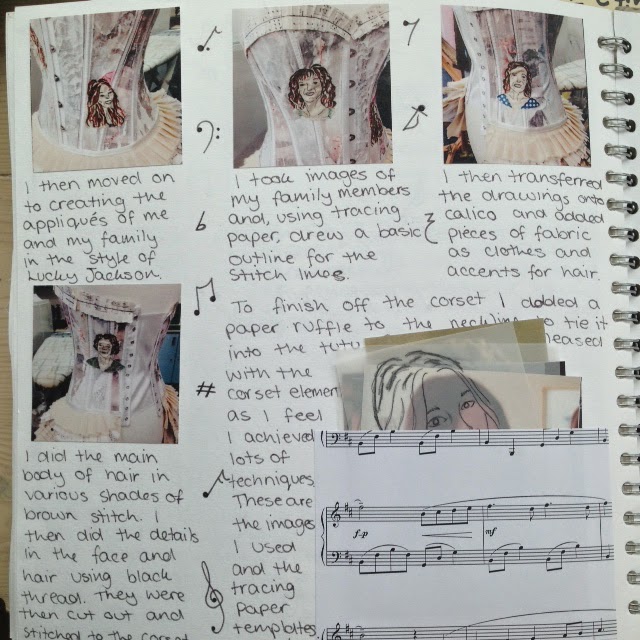
Once the base of the corset was done I moved on to the creation of the appliqués. I found images of four generations of my family; my great nan, my grandma, my mum and myself. I drew these out onto calico and added shards of fabric to the hair and clothing to add some colour and texture. I then stitched them using various shades of brown thread for the hair and black thread for the features and details. They were then cut out and stitched onto the corset, two on the back and two on the front. To finish off the corset, and to bring in more details from the tutu, I added a pleated ruffle of sheet music to the neckline of the corset. I feel this helped to link the two pieces together as one garment.


I am very pleased with the outcome of my corset. I feel it links in well with the tutu, with the calico panels and paper ruffle. This is also a very wearable garment, which illustrates my personal story of life through the figures in my family. I feel this was a successful addition to my tutu and overall final piece.

Thursday, 6 February 2014

Tutu Development

Following my research into Peter Clarke's paper tutu, I decided to start thinking of designs for my own final outcome. I drew up a few quick sketches onto tracing paper to look at skirt shapes and composition. I decided that the bottom left design shown in the image below was my favourite, as the tutu shape showed off the pleated layers, as well as the corset allowing the appliqués to stand out.


I then looked further into this design, looking at the specific ways in which to create such a garment. I decided on purchasing a plain corset to put the appliqués on, which would make them stand out. I also decided on what layers I was going to use in the tutu. I created a small sample of tutu to get the idea of what it would look like, as well as to test out my methods of pleating, stitching etc.


After creating the small tutu sample, I thought that it was lacking in detail, which might have detracted away from it. I therefore decided to add some stitched embroidery onto the middle layer. I felt that music would fit in well with the dancing theme, as well as being relatively simple yet effective. I wanted to copy real music as I felt it would make it more authentic, so I chose the theme song from Swan Lake to stitch into the calico, as it was the first ballet I went to see and also a favourite of mine and my family's. I created a sample of this stitched middle layer. When stitching, I decided to leave the threads hanging loose, reflecting the work of Tracie Murchison, as it added more texture and interest to it.


Having decided that these ideas were of what I had intended to create, I began to make the tutu, starting with the band for the layers to be stitched into. I tested the lengths of the layers on a mannequin before cutting out the panels and beginning to pleat them. For the sheet music stitch I started with the stave lines, and then embroidered on the music notes using an embroidery machine.


After I had stitched the music onto the middle layer, I attached the pleated calico layers onto the waistband of my tutu. I then experimented with lengths and pleating styles of the paper sections. I decided that rough edged, randomly pleated paper looked better, so I created my pleated papers and stitched them onto the band also. To finish off the tutu I added net layers under the paper and white satin binding along the top edge to give it a finished look.


I am very pleased with the outcome of my tutu. It turned out to be a high quality, wearable garment. This was something that was important to me, as being a dancer I understand the need of a practical garment in which you can move freely. I feel this is a successful tutu, showing influences from my journey through my sketchbook.

Further Artist Research

After my visit to the V&A Museum, I decided to look into some paper garment artists, to link with my research on the fan and ruffled collars. I initially found Michael Cepress, an artist who has created a series of paper collars. I recreated the three collars in 2D in my sketch book.


Following on from this I created my own 3D collar to develop further ideas on ruffled edges and different papers that could be used to create garments.


I also found Mauricio Velasquez Posada during my paper garment research. This artist creates oversized origami dresses from plain white paper. I started with 2D origami shapes influenced by one of his dresses, leading in to looking at full garments in different coloured and printed papers.


I liked the big paper tutu created by Mauricio Velasquez Posada, which inspired me to develop my research towards creating a paper tutu for my final outcome, as it would link into my dancing theme as well as showing off various artist influences. I started to look at different materials and pleating techniques to get an idea of which papers etc. would look best as a tutu sample.


I tested book paper, calico and a mix of both in small tutu samples. I liked the sample with two layers of calico with a layer of the paper in between, as it looked more multi-media as well as being more structurally sturdy. I then did a few 2D fashion illustrations with pleated tutu skirts on to get an idea of whether the idea would look good.


I finally looked at Peter Clark's paper tutu as a 2D design. I liked the messy look to this style of working, and feel that adding something like this to a 3D tutu could add more texture and interest.


This research has influenced my direction for my final outcome. I like the rough look to the ruffled papers seen in Michael Cepress and Peter Clark's work, as well as the oversized look to Mauricio Velasquez Posada's work.


Friday, 17 January 2014

V&A Museum Visit

Following on from my work on Lucky Jackson I decided to do some research on different garment types and ways to attach appliqué onto garments. I visited the Victoria and Albert Museum in London to observe the garments in the 'Fashion through the Ages' and costume exhibitions. I took lots of images of various garments, shoes and accessories and presented my favourite ones, and the ones that influenced me, into my sketchbook.


I really liked this tutu and the way the skirt was created is very different but interesting. The beading and flower additions to the corset top make it look much more detailed and intricate. I would like to include a few of these ideas and techniques into my own final outcome.
 

 The appliqué on this coat is very different. The faces are created out of stitch lines, with the odd bit of coloured fabric or beading to accent the eyes and lips. The Suffolk puff flowers on the top add to the texture of the garment. I think this idea is very interesting and I could maybe include a bit of these techniques into my final outcome.
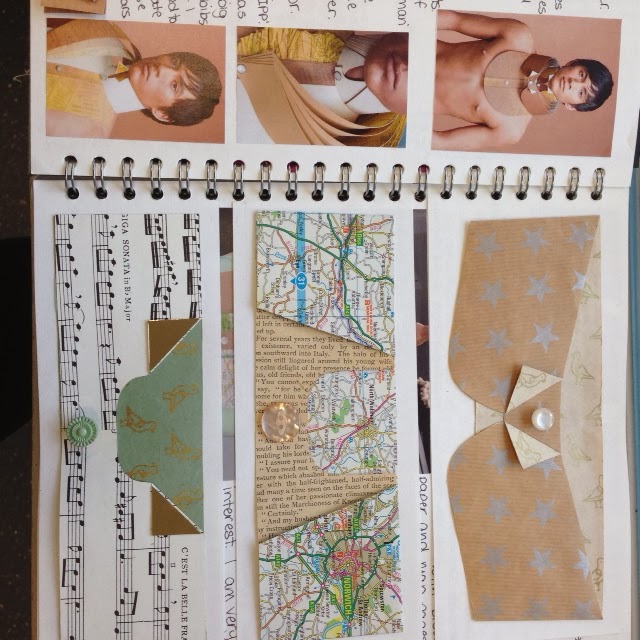

I really liked the simplicity of this Christian Dior fan. I also liked the ruffled collars and garment made out of old envelopes. I feel I could link these two ideas together to create some paper garments, with appliqué writing and images.


I feel the visit to the V&A Museum was very successful in inspiring me and influencing some decisions to further my development towards my final outcome.